LegalMatch Law Blog

Monday, October 26, 2009

Estate Planning Procrastination Rampant

If you could make sure that all your money, property, and other important belongings were given to exactly the right people, wouldn’t you do it? The question seems like a no-brainer but the reality is that the majority of Americans do not do this!
A 2008 study found that 58% of Americans do not have a will. I find this number to be shocking. I know that death and dying is an unwelcome topic, however dying without a will is a really bad idea. This holds true whether you are worth millions or a lot less. Wills, trusts, and other estate planning tools give you the power to decide how to distribute your estate.
When an individual dies without a will (or when they have an incomplete will), their estate goes through intestacy, which basically means the state decides how your estate will be distributed. This is especially risky if you have step or adopted children as some state’s do not allow an adopted or stepchild to inherit in intestacy, or those non-biological children inherit less.
A recent article I read outlines the top 9 excuses for people gave for not making any type of estate plan:
(1)I don’t see a need for an estate plan
(2)I don’t plan on dying
(3)I don’t plan on dying – at least not soon
(4)I don’t want to pay for it
(5)I don’t want to spend the time
(6)I don’t want to talk about my family
(7)I don’t want to talk about my money
(8)I don’t want to ruin my kids
(9)I don’t trust my kids
As you can see, some of these excuses are just avoiding the inevitable. One of the beauties of estate planning is that you have the ability to change the majority of your plan as situations change. Without an estate plan, you are putting your finances and property at the mercy of a judge who has no idea what you and your family are like.
A recent LegalMatch study found that the majority of people interested in preparing for their future were more interested in overall estate planning than drafting a single will or trust. These findings make sense in that those individuals that are thinking about wills and estate planning are really trying to maximize the benefits and thus are creating more complicated schemes than just a will or trust; and those individuals who are not are in the majority and doing nothing to plan. In addition to the ability to specifically provide for your family and loved ones, there are tremendous tax benefits to creating a will and/or trust.
It is not necessarily that I think everyone needs to embrace their own death. Rather, I am advocating for embracing the lives you will leave on your death. Estate planning is such a powerful tool and for all the time that people spend worrying about money and their families in their lives they should take a little time and worry about them after they die too.

Wednesday, October 21, 2009

LegalMatch Site Data Shows High Interest in Wrongful Terminations

According to our internal traffic statistics, it appears that one of the most popular law library articles on our website is about wrongful terminations.
Does this mean that your employer is going around firing employees left and right, just for fun? Probably not…unless you work for this guy.
More likely, the current state of the economy (in case you haven’t heard, it’s not doing too hot right now) has led to many people losing their jobs, with no sign that the bloodletting of employment is going to abate anytime soon. When someone loses their job, especially if it’s for economic, and not performance-related reasons, they are understandably upset.
However, the vast majority of terminations are perfectly lawful. In virtually every state in the U.S., employment is “at-will,” meaning that the relationship is completely voluntary, and dependent on the mutual consent of both parties. This means that employees can quit their jobs at any time, and that employers can fire them at any time, for any reason, or for no reason at all.
There are exceptions, however. For example, under federal law, and the laws of almost every state, it is unlawful to fire or refuse to hire a person because of their race, color, religion, national origin, sex, or disability (if it can be reasonably accommodated). Also, if the employee is working under an employment contract, they can only be terminated pursuant to the terms of the agreement.
Whether your termination is ultimately found to be lawful or not, it is not a bad idea to speak with an attorney if you suspect that improper motives colored your employer’s decision. It’s better to talk with an attorney for a few minutes and have them tell you that you don’t have a case, then to sit on your rights, and let a valid claim for wrongful termination slip through your fingers.
Many people seem to recognize this, and are using LegalMatch to help.

Tuesday, October 20, 2009

CNN Falsely Attributes Racist Quote to Rush Limbaugh

Rush Limbaugh is in the news again and this time it’s not because he said something horribly insensitive, stupid, narrow-minded, and/or racist. It’s because someone else made up an insensitive, stupid, narrow-minded, and/or racist quote and attributed it to him.

Specifically, that someone was CNN’s Rick Sanchez, who claimed on air that Limbaugh said:
“I mean, let’s face it, we didn’t have slavery in this country for over 100 years because it was a bad thing. Quite the opposite: slavery built the South. I’m not saying we should bring it back; I’m just saying it had its merits. For one thing, the streets were safer after dark.”

Ouch. Harsh words, whether Limbaugh said it or not. Check out the video here (the bogus Limbaugh quote comes up about 1 minute and 14 seconds in).
Limbaugh was understandably steamed at the fraudulent attribution. No one wants to be called a racist, unless of course they actually are one, then they’re probably okay with it.
So now the inevitable question being asked by political pundits around the country, “Will Rush Limbaugh sue for slander?”

The answer (in my opinion anyway): probably not. Rush will probably just want some sort of apology from Sanchez and CNN, which he already received via Twitter, though he’d probably would want more of a formal one. If anything, he’ll just use it to further push his far-right republican conservative agenda. “More evidence of liberal bias, using me as a target to demonize…blah blah,” is probably how it will go down.

Though if he did sue, he probably wouldn’t have too tough of a time convincing a jury to award him money. Since he’s (arguably) a celebrity, he’d be considered a public figure and would have to satisfy the higher actual malice standard set out in The New York Times Co. v. Sullivan in order to prevail on a defamation lawsuit against CNN and Sanchez. Basically he’d have to prove that the CNN and/or Sanchez knowingly or recklessly made false defamatory statements about him. And in light of the fact that the CNN Twitter post admitted to this, it would at least appear that Rush has a good case. Though CNN could probably throw up some defense by publicly admitting and correcting their mistake, in my opinion it looks like Limbaugh would have a strong case.

Celebrities have it tougher when it comes to proving libel and defamation – it’s one of the few times where all us little people have an edge. All we have to do, essentially, is prove the false statement damaged our reputation. Though it may seem like defamation wouldn’t be a huge problem for non-public figures, LegalMatch does receive its fair share of defamation lawsuits. So don’t be afraid to press your rights. Unless you’re Rush Limbaugh, in which case you should probably reevaluate your life and try to figure out why people would so naturally believe you’d make such an outlandish racist statement.

Monday, October 19, 2009

Frivolous Lawsuits Are a Bad Idea: Birther Edition

If you’ve been watching cable news, you’re probably aware of the “Birther” movement – a loose coalition of individuals and organizations promoting the idea that Barack Obama is, for one reason or another, not constitutionally eligible to serve as President.

They make a variety of factual and legal arguments to support their conspiracy theories. The most common “factual” (a term I use loosely) argument they make is that Obama was not actually born in Hawaii, as is widely accepted. Instead, they claim, he was born in a foreign country (usually Kenya). Of course, they ignore that a Certification of Live Birth has been released, and confirmed to be accurate by the relevant officials in Hawaii.
Others concede that he was born in Hawaii, and rely on dubious legal arguments to support their claims. Some claim (usually without citing any supporting authority) that, in order to be a “natural born citizen” under the meaning of the U.S. Constitution, both parents must also be citizens of the United States. To be fair, the Supreme Court has never firmly ruled on what it means to be a “natural born citizen” under the meaning of the Constitution. So, the birthers have simply settled on their own definition, to the exclusion of all other possible definitions.
To support this point, they often rely on the writings of a Swiss political philosopher named Emerich de Vattel, author of the 1758 book “The Law of Nations.” This tome was apparently quite influential in the early development of international law, and it advocates the idea that, for a person to be a “true” citizen of a nation, both of his or her parents must also be citizens.

There’s just one problem: no evidence suggests that this work particularly influenced the framers of the U.S. Constitution when they were drafting that document. Even if it did, a Swiss book on political philosophy is not binding legal precedent in the United States.
None of this has stopped a dentist/lawyer named Orly Taitz from filing a lawsuit challenging President Obama’s eligibility to serve.

The result? The case was dismissed almost immediately. However, Ms. Taitz continued to file motions, and, after repeated warnings from the judge, was slapped with a $20,000 fine for misconduct, noting that she made no coherent legal arguments, and that her briefs and motions read more like political manifestos than court documents.

It should be noted that one of the best things about this country is the fact that you can say almost anything about anyone, especially elected officials, with relatively few legal ramifications.


However, that does not mean that you are guaranteed a platform to air your views, or that you get to use the courts to air whatever crazy idea happens to pop into your head. If that were the case, I’d be in court right now, arguing the merits of hamburger earmuffs.

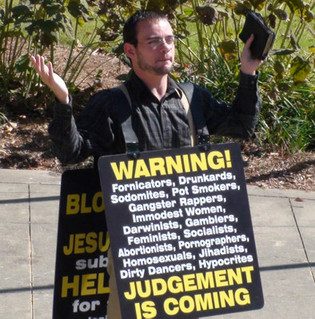
In the end, we should all remember that the courts are a place to settle genuine legal disputes, and the non-issue of Mr. Obama’s citizenship is not one of them. Ms. Taitz has every right to express her political views in any number of ways. She could buy space on a billboard, she could run spots on the radio, or she could simply make like this guy.

Thursday, October 15, 2009

The Necessity of Disrupting the Government to Save the Environment

As the end of October nears, children everywhere are wetting their pants in anticipation for the one time of year where wearing a Spider-man costume and asking for candy won’t land you in jail. Ahhh Halloween, how we love thee. It’s everyone’s favorite holiday, unless its hot sister Christmas is around, in which case take a message and tell it we’re washing our hair. Halloween is great. It’s a time for pumpkin-carving, trick-or-treating (as long as you don’t live in New Orleans), and of course, pranks.
Sometimes a well-laid prank can be even better than all that candy. Who doesn’t love leaving a flaming bag of dog poop in front of your cranky neighbor doorstep or covering said neighbor’s house in toilet paper? Not to mention the all-time classic, “bidding on a federal auction for oil and gas leases when you don’t have the money or intention to follow through on it.”
Don’t remember that one? It was all the rage when I was still in elementary school. I remember how my friends and I would dress up in a suit and tie, go down to the old Bureau of Land Management, or BLM for all you youngins, and place a phony bid posing as representatives for a kooky billionaire. Still doesn’t ring a bell, huh? Oh well, I guess I’m just getting too old to keep up with all these new fangled pranks…
But at least there’s one person who is keeping it alive. But Tim DeChristopher is doing it for an entirely different reason. Making a stand for the environment?? Psshtshaw… Whatever happened to just messing with people because it’s fun?
Seriously though, this is a very serious offense. DeChristopher is being charged with two felony counts, carrying up to five years in prison plus fines up to $750,000. The reason he did it was to cause disruption in protesting what he believes are governmental acts that are contributing to the rise of global warming.
But whether you believe in DeChristopher’s cause or not, you’ve gotta admire the legal defense he’s planning to use: a necessity defense. It’s basically a choice of evil defense, where a person is forced to choose between breaking the law and preventing some evil/harm, or letting that evil/harm happen. The article does a good job of summarizing DeChristopher’s chances of succeeding with this defense. Though I think they missed one important aspect: standing.
Usually to employ such a necessity defense, especially against the federal government, a person would have to show that he or she was actually harmed by the actions of the government. No actual harm usually equals no defense. I say usually because like every good law school will teach a first-year student, it depends.
I suppose DeChristopher could make some argument that the harm to the environment hurts the planet which in turn harms his life expectancy by increasing the chances of natural disaster or depleting the ozone layer which would lead to increased exposure to harmful UV rays. But looking at most case precedent, these types of arguments are considered too nebulous and broad to ever succeed.
Good for him for trying though. The number of lawsuits received by LegalMatch regarding environmental issues, land-use, and toxic torts has increased by approximately 20 percent from last quarter, so it seems like they’re all the rage now. So maybe Lady Luck will smile in DeChristopher’s favor, though if you ask me, she’s probably terminally ill from skin cancer…

Monday, October 12, 2009

Public Option Health Care Reform Voted Down By Democratic Congress… Anyone Else See The Problem With That Headline?


With the democratic vote down of the public option of President Obama’s health care plan, the tired, poor, and huddled masses yearning to breathe free are understandably upset. Essentially, free public health care for those who need it most sounds like a no-brainer, right? Apparently not. It’s fine, I guess. I mean, who cares about the health of poor people? Those sub-humans have been dragging our economy down for, too, long. Always complaining about how hungry and sick they are. Such a group of whiners…

Was I laying the sarcasm on a little too strong again? Sorry, bad habit of mine. *sigh* The rich not only seem to be getting richer, but they also seem to be able to dictate how this country runs…

Anyway, I guess it’s back to the grind for all us working-class schlubs (and humble bloggers) since we don’t have the luxury of extended vacations and daddy’s money to preserve our physical and mental health.

That’s no joke either. The working class really does need to keep on working in order to stay above that proverbial poverty line. Even under an employee co-pay system, the average cost of health insurance for a family of 4 in America is $13,000. $13,000 is a lot of money, but considering this amount is over a third of what the average person makes in a year and the fact that food, living, and incidental costs just keep going up, you’ll start to get a better picture if how important that chunk of income in. Not to mention how important and vital a publically funded health care option really is to the vast majority of citizens in America. Oh, and by the way, don’t forget that the average cost of raising one; ONE child to adulthood (which is 18 years old, just in case any of you alcoholics out there think it’s 21) ranges between $124,000 to over $250,000.

Another interesting note is that single parents with incomes over $39,000 actually spend more on their kids than two-parent households. Guess missing a parent makes you more likely to throw money at your kid’s problems. Wish my parents did that with me…

Having free, or at the very least, affordable health care for people and their families in light of these statistics emphasizes how vital the public option really was and is. People will always fight over money simply because there never seems to be enough of it to go around, whether that money is taken from them through taxes or services that were once free, but no longer given as such. It’s no surprise then why according to the latest statistics from LegalMatch, over a third of all litigation raised against employers is regarding coverage of employee benefits. In other words, health insurance.

It’s a brain-teaser how this new democratic congress voted down such an important reform. I mean, the majority of citizens seemed to be for it. And last time I checked, public official were supposed to be elected in order to represent the people’s interests. I guess we’ll never know why thing turned out like they did. But I wonder if someone might have some clues that could point us toward this anomalous outcome.

Thursday, October 8, 2009

@defendant – plz to cease n desist kthxbai

Alright, I’ll stop now. If you haven’t already closed your browser in disgust (and I don’t blame you if you have), you may be wondering what this is about. According to the ABA Journal, the highest court in the UK has allowed an anonymous blogger to be notified of an injunction through a Twitter message.


The blogger in question was impersonating a well-known English lawyer, Donal Blaney, who also happens to be a frequent conservative commentator. In his blog, the anonymous blogger apparently held himself out to be Blaney, and wrote articles under his name, promulgating caricatured political positions.


Because the identity of the anonymous blogger could not be readily ascertained, and Twitter was the easiest way to contact him, the court granted Blaney’s request to serve the injunction via Twitter. The Twitter message sent to the blogger contains a link to a copy of the injunction, and orders him to immediately cease impersonating Blaney, and to reveal his identity.

This follows on the heels of a ruling by an Australian Court, a defendant was served with notice of a default judgment through Facebook.

Apparently, courts in Australia are well known for their tech savvy, already allowing service of process via email and text messages, so such a move is to be expected. The question, then, is when should we expect such forward-thinking actions from American courts? If I had to guess, I’d say we have a while to wait, considering that some of them haven’t yet mastered advanced staple technology.


In all seriousness, this does raise some interesting questions about how service of legal documents should be handled in the digital age. The courts of most U.S. states, and the federal government, call for service to be delivered personally, in a hard copy. This is certainly the preferable method, as it all but eliminates any uncertainty as to whether or not service was actually received. However, it’s not always possible, for a variety of reasons. In such cases, “substituted service” – leaving the documents with another member of the person’s household, or at their place of business, is acceptable, as is service by mail.
Really, though, given the fact that most people in the developed world use email, and many also use social networking sites, wouldn’t allowing service by electronic means make sense, at least if other methods of service fail? After all, you can now check your email on almost any device that has a screen, and most people check their email on a daily basis. It would be pretty hard for someone to claim with a straight face that they haven’t received service, if they could receive it via email.


Of course this raises issues, as well. Once it becomes accepted that you can receive notice of a lawsuit via email, it won’t be long before the scammers realize that they can separate fools from their money by emailing them fake summons, and telling them that this pesky lawsuit can go away for a reasonable fee.

So, there are a few kinks to work out of the system, but in cases such as this, when the defendant is clearly a real person, with ready means of contact, but cannot be identified for whatever reason, it seems that justice could be served much more efficiently if this method of service were allowed.

Wednesday, October 7, 2009

Child Custody Battles In My Own Backyard

In my opinion (IMO, to you all people who can’t pry yourself away from the interwebz) a person goes through a number of stages in their life: childhood, adolescence, young adult, middle-aged, then old dude or dudette. That’s generally how most people see life, too. But within these stages, there are a bunch of sub-stages that occur, most interestingly between young adult to middle-aged. I’m in an odd/interesting/sad stage right now. I’m right around the age where everyone is starting to get married, but also I’m getting closer to the age where I’m starting to know people who are getting divorced. It’s weird – whatever happened to the stage where we’d all play around in the sandbox and make mudpies? Oh, childhood, why did we have to leave you?

Anyway… recently, I ran into an old friend, Joey, from high school and we ended up talking about his life since I last saw him. Joey was a pretty popular kid when we were in school together. Despite the fact that our school didn’t have very strong sports teams, Joey was a star-player on our school’s basketball team nonetheless, which is why he was also popular among a lot of the female students. And in our senior year, Joey hooked up with Deborah, a shy, yet nice girl from our school. Everyone thought they were the cutest couple and that they were headed to good successful places. So when Joey told me that he was getting divorced, I was shocked. Even more surprising was when he told me how things between he and Deborah had soured to the point where they were no longer talking and that he was locked in a bitter custody battle with her.


I was shocked, even more shocked than when I discovered the drying power of ShamWow!
Joey wanted to have primary custody of the children. He told me how other divorced guys he knew all either lost complete custody of their children or were limited only to visitations rights. Joey didn’t want to keep Deborah from seeing their children. In fact, he wanted her to be a very active part in their lives. But what he didn’t want was to become like all the other divorced dads he knew. He didn’t want to be limited to only visiting his children because he was worried that it’d make his children distant. He wanted to know what his options were.


Well, I didn’t know what to tell him since anyone in or heading toward a career in lawyering knows that the answer to every legal question is that “it all depends.” Laws can be ambiguous and outcomes vary all the time and are dependent on a number of things as facts can always be distinguished to appear different from other cases tried before it.


Generally, in California and most states, courts usually award custody to the primary caregiver, meaning the person who spends the most time with the child. Usually that translates to the person who doesn’t hold paid employment and raises the child, but when both parents work, like in Joey’s case, it comes down to fitness and a calculation of time spent with the child.
Joey isn’t alone in his predicament. A vast majority of family law cases received by LegalMatch are about child custody battles.

The best advice I could give to my friend was to seek the counsel of a qualified family law lawyer. Because regardless of the legal situation, case outcomes are not always predictable.


Tuesday, October 6, 2009

Supreme Court Considering Landmark 2nd Amendment Gun Case

Whatever your thoughts on gun control, news like this gets law geeks and wannabe scholars of constitutional law (such as me) pretty excited.

In short, the Supreme Court has granted certiorari (Fancy Lawyer Talk for “agreed to hear”) to a case which will, one way or another, fill a massive gap in our 2nd Amendment jurisprudence: whether or not the 2nd Amendment applies to states, as well as the federal government.
Last year, the Supreme Court, in District of Columbia v. Heller, ruled on the meaning and scope of the 2nd Amendment for the first time, holding that it protects an individual, rather than collective, right to possess firearms for private, lawful use, including self-defense. However, because a Washington, D.C. law was being challenged, and D.C. is technically governed exclusively by the federal government, the Court only ruled on the 2nd Amendment as it applied against federal law. This makes sense, because the Court could not have incorporated any 2nd Amendment rights against the states without first ruling on the meaning and scope of the rights that it provides.

In Heller, the court essentially held that the 2nd Amendment protects the right of individuals to keep handguns in their homes, for self-defense and other lawful uses. More specifically, Justice Scalia’s majority opinion held that individuals have a right to possess firearms that are “in common use at the time” for lawful purposes, but left open a great deal of wiggle-room for the government to put restrictions on the possession and use of firearms, such as banning guns at sensitive facilities, schools, or banning possession of guns by minors, the mentally ill, or convicted felons.

The upcoming case, known as McDonald v. Chicago, challenges Chicago’s handgun ban, and the ban’s opponents appear to argue that the Heller decision should be applied against state governments, as well.

Originally, the Bill of Rights (the first 10 Amendments to the Constitution, which protect our rights of free speech, freedom of religion, the right to trial by jury, etc.) only applied against the federal government. However, after the passage of the 14th Amendment, beginning in earnest in the early 20th century, the Supreme Court began to apply those protections against state governments as well (a process known as “incorporation”), relying on the 14th Amendment’s Due Process clause as its rationale for doing so.

Considering that the legal meaning of the 2nd Amendment’s “right to bear arms” was settled a little more than a year ago, after around 150 years of scholarly debate, the pace at which the Court is moving in filling in the centuries-old gaps in the law is quite impressive. Perhaps they feel as if they have some catching up to do? Or, as a more cynical person might argue, perhaps the conservative wing of the Court is simply granting cert to these cases so they can decide them before one of them retires and is replaced by an Obama appointee.

Whatever the result of this case, it is certainly going to ignite a storm of scholarly debate over the meaning of the 2nd Amendment, and its relevance in modern times.

According to recent LegalMatch case data, the majority of prospective clients who sought an attorney for a criminal case related to gun possession had no prior arrests. While it is impossible to know the exact circumstances of each case from this data, it is possible that many of the crimes which these people are charged with would cease to be illegal if the 2nd Amendment is incorporated. As for those who have prior convictions, they’re most likely out of luck, given the leeway that the Court has already indicated it is willing to give the federal government, when it comes to keeping guns out of the hands of convicted felons.